Tuesday, July 24, 2012

Good Thing #26: Hi Fi

I finally managed to get my stereo system hooked back up this week. Sadly, it's been years since it was all together. It's an old-school system of many parts (pre-Klipsch Aragon and Acurus components hooked into Magnaplanar speakers, if you care about such things). I spent more on it than I have on most cars that I've owned. But really, I've been working on it for more than 20 years, and I bought the most expensive pieces when I was a bachelor, working jobs that paid me far more than I make now. I was very aware that I had a window when it would be OK for me to spend such extravagant amounts on pure entertainment. But I was also aware that if I invested the money it'd be a one-time buy. Good audio equipment lasts. The Magnepan speakers I bought more than 15 years ago sound every bit as fantastic as when I bought them and with any luck will continue to do so until I lose my hearing. 

I don't consider myself to be an audiophile, however. In fact, I blame audiophiles for destroying the audio industry by fetishizing the equipment while losing sight of the fact that the whole point was to be enjoying music. MP3s with their compressed range, crappy earbud speakers and car stereos helped to nail the coffin shut, but even before those came about, the audiophiles made it possible. If you stepped into a high-end audio shop in pre-iPod days, you could expect to be belittled and scorned if you didn't identify as an audiophile. You were treated like an idiot if you didn't think spending $7,000 + on a pair of speaker cables was a good idea when there was no real evidence showing that they sounded any better than lamp cord from the hardware store. The general public had already been alienated and when MP3s came around, nobody was there to make the argument against it. 

The argument would have gone along the lines of, "MP3s are OK, but you're trading convenience for quality. You're only hearing maybe 10% of what the artist intended for you to hear." Then I might have brought you over and sat you down in a chair strategically positioned for optimum listening, and I would have played for you the same piece of music on your MP3 player and on the stereo, and hopefully you would understand that both convenience and quality have their place.

That should have been the role of the audiophiles, as defenders and educators of what quality music really means, gently guiding people to make informed choices about their listening. Instead audiophiles copped an attitude and insulted anyone who didn't get it. Now we have a generation who have only heard recorded music through headphones attached to MP3 players or from car stereos. And the audiophiles have become even more insular and elitist.  

But I digress. The point is, my stereo brings me pleasure because when the music is playing, it's as close as I can get to hearing it live. Even better in some ways because I can set the volume to levels that are comfortable for my ears, and I don't have to deal with crowds. While I love the convenience of my iPod/headphone arrangement, when I hear a note I might know it was plucked on a guitar. On the stereo I can hear the differences between the kind of guitar, that it was made of wood and had a hollow body. I can hear the differences between the acoustics between a small, warm room and a large, cold room. With the MP3, music is just the background soundtrack to my life while I do other things. That's important and has its place, but when I hear that same music on the stereo, I'm aware of the music as a work of art created by an artist, or many artists, who are trying to communicate a message and share a feeling that's important to them. 

It's a simple joy to sit back and listen, really listen to music. 

Monday, July 23, 2012

Good Thing #25: Pennies

Some people hate pennies. One of the chief complaints is, "It costs more than a penny to make a penny." That's a stupid argument, though. All our money could cost more to make than it's denomination and it wouldn't matter because it's not the physical value of the actual object we're trading  when we give someone money in exchange for goods and services. The monetary object is just a tool, a symbolic way to keep track of the amount of value we're trading for something. A single penny may be exchanged tens of thousands of times during its lifetime. If something that useful only cost pennies to produce then it was a bargain.

Pennies are nice, though, in that they are almost worthless, but not quite. When I have the opportunity to leave pennies in the, "Leave a penny, take a penny" bowls by cash registers, I do, and I feel good about it because I've made someone's life a little less annoying by doing so because now they'll be able to make exact change. The times when I've had to use that bowl, I've been very grateful to the person who left their pennies there. It's a win/win!

I also don't carry pennies with me. If there are any in my pocket at the end of the day, they go into the penny jar. And they keep going into the penny jar for months, even years, until we're short on funds. Then we roll them up and there's always a surprising amount of money we didn't realize we had. So, yay pennies!

Good Thing #24: Antiques

Some good things you just want to keep to yourself because if everyone knows about them, they're not going to be as good. Fortunately, nobody reads this so I think I'm safe.

I used to think things like antique furniture was something only the wealthy could afford. That may have been the case a while ago, but now it's the way to go. The majority of new furniture seems to have gone the way of Ikea. Cheaply constructed, semi-disposable laminated particle board, with no charm and no longevity. Ikea could get away with it because the price reflected the quality. But now even cheap furniture isn't all that cheap, and good furniture is ridiculously expensive.

We like having nice things in our lives, but we're on a budget. So we've been buying our furniture at antique stores. Surprisingly, you can find many pieces there for less than what you'd buy the equivalent new. The big difference is that the piece you buy at the antique shop is made from solid maple. You know it's going to last, because it's been used for a hundred years or more already. Most likely it was hand made. Only the wealthy could afford to buy new furniture of the quality that you can find in antique shops for short change if you look around.

If you're willing to accept the fact that your night stand might not match the bed, you can fill your life with hand-crafted, American-made hardwood furniture without breaking the bank! That's the route we're going, and it's very satisfying.

Good Thing #23: Masterchef Australia

If there was a way to legally watch Masterchef Australia in the US, I wouldn't advocate pirating it. Unfortunately, as far as I know, that's our only option. Do it. Go to Pirate Bay and search for Masterchef Australia and torrent it right now. It's the gold standard for what reality programming can be. If you're into cooking or into competitive reality TV, go get it now. If you've ever watched such shows and it seemed like they weren't living up to their potential, go get it now. Here's reality programming raised to the level of a true artform.

A word of warning, though. After watching Masterchef Australia, it's hard to watch the US versions of Masterchef, or even Hell's Kitchen. They just seem embarrassing now.

The key difference is that Masterchef Australia understands drama. The US version too often reverts back to the comfortable, understandable standards of sex and soap opera. Masterchef Australia understands the real drama is in the food and in learning to become better chefs. You can actually learn to be a better cook and to better appreciate the food you eat by watching the show.

Masterchef Australia dispenses with the hero and villain cliché of the US version, where there's cooks you route for and cooks you hate. Instead, all the cooks are likable and we really want to see them all succeed. The cooks actually support and encourage each other as well, and become friends as show progresses. The approach really notches up the drama. Instead of the "I'm not here to make friends," line we get the victor's conflict because their victory is at the expense of someone they care about.

There have been episodes that made me exclaim, "THAT'S how you do drama!" because the show frequently goes beyond what makes good reality programming and into themes that make good cinema, or good novel writing. It has that kind of power to make us engage emotionally with the characters and feel triumph and heartbreak as they do. That's a remarkable thing in any medium, but for it to happen in what's typically the lowest point in our culture is just amazing.

Good Thing #22: Bruce Campbell

Bruce Campbell was born at the wrong time. In the 30's or 40's his heroic good looks and mighty chin would have cast him as a Hollywood leading man. Sadly, we're living in a post-heroic age, so when Bruce Campbell is cast in a heroic role, it's with ironic or humorous intent. Fortunately, he's gets the joke, and it's a role he plays very well. Everything he stars in is better for having him in it. From numerous B-movies to classics like Evil Dead and Army of Darkness, to his current supporting role in the TV series Burn Notice, Bruce Campbell is like salt. Almost every recipe is better with it. Even really bad movies like Alien Apocalypse are better because he's in them.

Friday, July 06, 2012

Good Thing #21: The Deli

The deli section in the supermarket is too easily overlooked. After all, you can get most everything in the deli in the refrigerated sections of the supermarket, so why take the extra time?

First off, it's often cheaper. The deli section often has specials on things that aren't discounted in the cooler. I think it tastes better, too. A hunk of cheese cut of a big block has a better flavor and texture to it than those small, shrink-wrapped vacuum sealed bricks. I also like the human interaction. The people who work the deli counter tend to be friendly and cheerful. If I remember correctly, the deli section is somewhere you get promoted into. It's a desirable position to have. So the people who are there are the supermarket "pros" and they want to be there, so they're great to deal with. You can also get your cheese and meat sliced exactly to the thickness you want.

The thing I like to do when I go to the deli is to request "about a pound" of cheese in a solid block. I'm okay with a little more or a little less. I just don't want them to be timid with their cut. Invariably, they almost always spot on, never more than a hair's weight off. It's really impressive since they're cutting by eye.

Go to the deli on your next trip to the supermarket. It's one of life's small joys.

Good Thing #20: Administrative Assistants and Custodians

It's a Good Thing 2 for 1 special today, because I couldn't find a concise way of saying, "The people who matter a lot more than most people realize."

If there's a word of advice I'd give to young people starting out on their careers, it's, "Suck up to the boss, but make friends with the administrative assistants and the custodians." The first part is obvious, and many people stop there in their relentless pursuit to get to the top. These people typically make more than me, so maybe you should pay attention to them. However, I think I've had a more enjoyable life by paying attention to the second part.

Custodians and administrative assistants tend to know a whole lot more about what's going on in any organization than most people realize. For a lot of people, since they're not going to help you "get ahead" they're invisible unless they're needed to staple something or clean up a mess. And so people are a lot freer with their information around them. Custodians also know what people are throwing away. Administrative assistants handle the flow of information across their bosses' desks. So they're often plugged in in ways that people don't realize. Administrative assistants sometimes have magic powers they can use in your favor if they like you. They might be able to enter hours you were out sick as hours you were working in payroll, for example.

In my experience, I've found that custodians and administrative assistants are there for you in ways that upper-level employees can't or won't be. They've got your back and will put a good word for you in the right ear if they can. They'll also help you jump your car if your battery is dead. If you drop your security pass they'll get it back to you instead of giving it to security like they should, saving so much hassle.

The catch is, my advice said make friends with them. You can suck up to the boss and it's socially acceptable for this to be completely superficial because you're only doing it to get ahead. It's not OK to do that with a custodian or administrative assistant. They'll know. Instead you're going to have to do things the old fashioned way. Get to know them by name. If they need help with something, give it to them. If you need something done, ask nicely, saying "please" and "thank you" even if according to company hierarchy they're your subordinate. Don't leave messy, sloppy stuff in your waste basket that's going to be a pain for somebody to clean up. Be a friend and you'll make a friend.

So anyway, thanks to all the custodians and administrative assistants who've been so helpful to me all these years. You are truly appreciated.

Tuesday, July 03, 2012

Good Thing #19: Chocolate

Chocolate.

Do I need to say any more than that? If you agree than I don't need to explain. If you don't, there's nothing I can say that will change your mind.

Someone once said, "The best things in life aren't things." Probably a 1%-er, trying to find a myth that will keep the rest of us from rebelling and tearing this whole sick system down.

They're obviously wrong. Chocolate is absolutely one of the best things in life.

Monday, July 02, 2012

Good Thing #18: Bone Folders


Using the right tool for the job makes a huge difference, no matter what that job is. To most people, folding paper probably does not seem like an act that would require a special tool. You just fold the paper in half and run your finger along the fold to make the crease, right? 

When you use a bone folder, that crease it tight, even, and clean, and it stays folded. It turns a task you never really think about into a pleasure. When you can turn the ignored corners of your life into enjoyable acts, then your life is that much better!

You can find bone folders at most art supply and all book binding supply stores. Unfortunately, it has to be bone. There are plastic folders out there, but they're just don't work as good as the real bone does. We have several in our house, and we keep them in those little nooks where the pens and pencils accumulate, because you never know when you're going to need to fold something. When you do, it's good to do it right!

Good Thing #17: The Voynich Manuscript


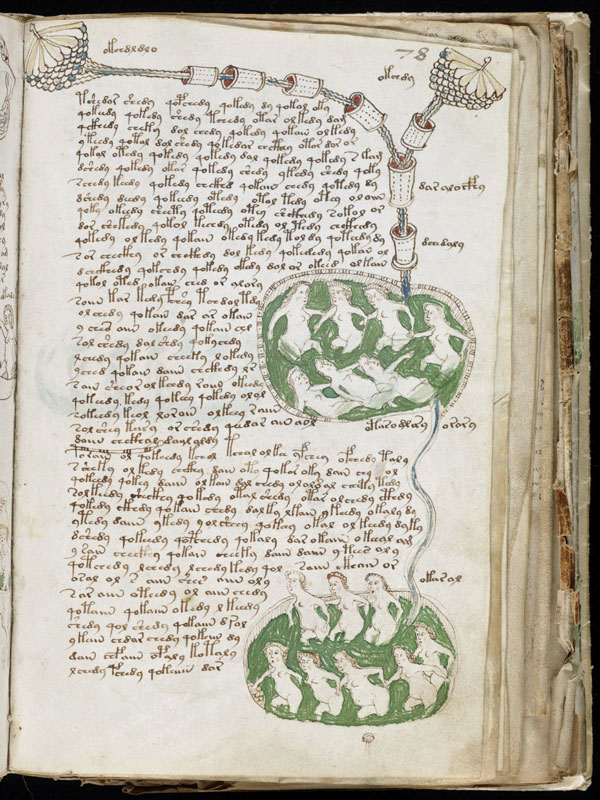
The Voynich manuscript is an illustrated book of about 240 pages, written most likely in Italy in the 1400s. That's about all anyone knows for sure about it. It's written in something that has the attributes of a language, but over the past hundred years none of the world's top cryptographers have been able to crack it. Many of the illustrations are of plants that have never been known to exist. It's been dubbed "the world's most mysterious manuscript." Just Google it. There's a wealth of information out there on it, and all of it will just make you wonder more. 

That's why the Voynich manuscript makes me happy. We live in times where it feels like everything is defined, regulated, understood, put in neatly labeled compartments. And here's this object that has defied all that for almost 600 years. Maybe it's just a hoax, but what a hoax! A hoax that has kept people wondering for more than half a millennium is a wonder itself.  Or maybe it's not a hoax at all, but an actual record of places and things that only the author had access to.

Either way, it's a reminder that there are still wonders in the world. 

Saturday, June 30, 2012

Good Thing #16: Peter's Alive

A little over year ago my dear friend Peter was dying from a liver condition that would certainly have killed him were it not for the wonders of modern medicine, his will to live, and love and support from family and friends. Now he's healthy. He just got back from his honeymoon. He's buying a house and planning for the future. That's great for him. What's great for me is I still have Peter in my life.

Thanks for still being alive, Peter! The world is a better place for having you in it, as is my life!

Good Thing #15: Marriage

Jess and I just celebrated our sixth anniversary this past weekend. By celebrate, I mean we tried to take a trip down the coast for a romantic day of exploring and antiquing, but between Jess being extremely pregnant and me still recovering from the last surgery, we wound up mostly doing lunch at our favorite restaurant and then calling it an early day.

I don't intend for that to sound depressing. One of the great things about marriage is it lets you take a longer view on things. A lavish celebration of affection isn't all that feasible right now, but we're together for life. We'll make up for it many times over. In a short time we'll have a baby girl to multiply the celebrating.

I don't think Jess will ever let me live this one down: A year or so after we got married, I said, "You know, marriage doesn't suck nearly as much as I thought it was going to." It sounded better in my head before I said it. Before I got married, I really never intended to get married. I couldn't see the point. The majority of marriages end in divorce. As an atheist/anarchist I don't really need to have a marriage legitimated in the eyes of the church or state in order for it to be real to me. I'd already planned to stay with Jess for the rest of my life. So really, what was the point?

Ultimately, it was simple math. Jess's family really wanted her married. Jess wanted to be married. It really didn't matter to me, but with little effort on my part, I could make a whole lot of people I cared about happy. Plus: presents!

Maybe indifference is not the attitude one should go into a marriage with, but it worked for me. I went into married life without all the baggage. I wasn't looking for marriage to complete me, didn't think it meant an automatic "happily ever after," wasn't really expecting anything to be different save for it'd be a little more difficult to break up if we got bored with each other.

Much to my surprise, marriage did change everything, in many unexpected and happy ways. As much as I like to think of myself as someone who makes his own rules and isn't defined by society, society has other ideas. It really is easier to be married when you're of an age that people expect you to be married. You're treated with more respect. People take you more seriously. Doors open up that you had no idea were even closed. The world really does treat you better when you're married. Part of me bristles at that because I strongly believe that people should be valued for who they are, not for their labels, but in this case I'm benefitting it, so I'm not going to fight it!

But that's really the least of it. Even though I'd planned on staying with Jess for the rest of my life already, there really is something different having a ring on my finger that reminds me of that in a wonderful way. No matter what happens, no matter how bad things get, we're together and we'll make it work out somehow. Even if we don't know what the solution is going to be, we'll get through it. There's a difference between intending to be together forever and actually thinking like you're going to be. The good things are things you'll maintain, sustain and grow, and keep on growing for years to come. The bad things are things you'll overcome, together.

I've become a much braver person since getting married. I would never have bought a house on my own, or gone back to school, or done many of the dozens of crazy things I've attempted over the past six years if I didn't have a wife there reminding me it's better to try, and that she has my back.

Together we dream bigger, try harder, and go farther than we ever would on our own. Every day I'm reminded what a great choice I made when I decided to marry Jess.

Sunday, June 24, 2012

Good Thing #14: Stovetop Popcorn Poppers

Somehow, popcorn sellers managed to make popping popcorn seem like a difficult ordeal, so much so that unless you buy pre-bagged, pre-seasoned popcorn in microwavable bags, it's just too difficult to manage. So people wind up spending way more than they need to for popcorn that tastes so bad it doesn't deserve to be called popcorn when they could be spending far less for much better popcorn, with only a minimum of extra effort.

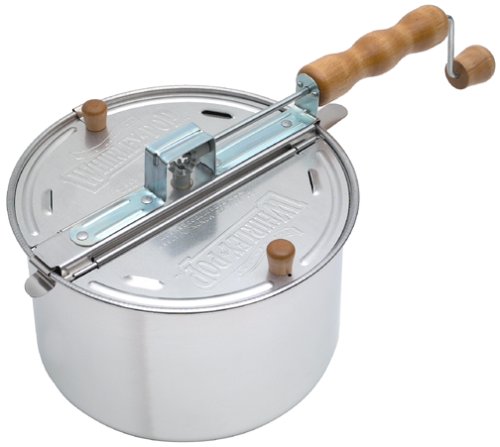
All you need is one of these:
There's a variety of brands out there, Whirly Pop, Great Northern, Cook'n Home, and others. There are debates over which is the best, but we've found them all to work just fine. Whenever we see them at yardsales, we'll buy them to convert family and friends. New you can find them for under $20, though. 

Put in a splash of oil and some popcorn and heat it on the stove while turning the crank, and about three minutes later you'll have six quarts of fresh popcorn. Is that really so much harder than doing it in the microwave? 

Once you've made the initial investment, popcorn costs pennies a batch. Far, far less than microwave popcorn. It's more environmentally sound because you can buy the popcorn in bulk and you won't have that popcorn inside a paper back inside a plastic bag inside a box. 

Most importantly, it tastes great. Popcorn made this way tastes infinitely better than microwave popcorn. Plus you can choose exactly what to put on it for toppings and how much. You can even add seasonings while it cooks for special treats, like kettle corn. 

We usually make popcorn this way a couple times a week. It's a great way to make an evening movie seem like an event. It's also a guilt-free snack. 

Saturday, June 23, 2012

Good Thing #13: Waking up Early

I love the early morning neighborhood, when I'm the first one up and there are no cars going by, and it's just me and the crows. And slowly, I can hear it all wake up. A car engine starts, a dog starts barking, a door slams. But a little bit at at time, as if the entire neighborhood is just trying to ease into the day.

I love the way the cats follow me down stairs, and rub up against my legs as I make my coffee. Dash usually wanders back upstairs to sleep on Jess, but Dot sticks around until I sprinkle more food into dishes that already have catfood in them. Then I have to pet her while she eats. It's our morning routine.

I love sitting in peace and quiet solitude while I drink my coffee and my brain starts working. Soon people will be up and the business will start, but for a moment the day is completely mine.

Friday, June 22, 2012

Good Thing #12: Meeting P. Scott Makela


Some people you know for a short time, but you're changed forever by them. Hopefully in a good way.

P. Scott Makela changed graphic design in the '90s. He defied convention by overlapping text, violating borders, using text as a graphic element and not just for communicating a message, daring to be ugly and dissonant. There were other designers at the time who did something similar, but the difference between those and Scott is the difference between a talentless musician who plays a few random notes on a trumpet and calls it jazz and Miles Davis. The 90s were an interesting time for design because of the advent of desktop publishing. A lot of people broke into the industry not because they were talented designers, but because they knew how to use computers. A number of designers violated graphic design conventions because they didn't know any better. The best of them just pushed their lack of ability to the point where it looked intentional. P. Scott Makela, however, was classically trained in Basel. Every transgression against design convention was done precisely and deliberately. 

I had the good fortune of taking classes from Scott at the Kodak Center for Creative Imaging and it changed the way I design. At the start we had to pick our favorite and most hated fonts, and explain why. From then on we could only use the fonts we hated. We were allowed, however, to go into the font with Fontographer and edit the font to change it into something we liked. That's actually way harder than it sounds and I wound up with a font that looked totally schizophrenic because of my lack of ability, but turned out to be perfect for what I needed it to do. It was an eye-opening experience. Designing with a font you hate can actually push you to design something better than if you'd gone the conventional route. 

I always thought P. Scott Makela deserved a whole lot more attention and credit than he got. Sadly, he died in 1999 at age 39, before his titles for the movie Fight Club made it into the theaters. That might have been his breakout moment. Still, I'm grateful to have met him, and I still use what he taught me to this day. 


Wednesday, June 20, 2012

Good Thing #11: Streaming

I admit it. I love TV. Way too much of my time gets sucked up by the idiot box. However, we got rid of cable years ago. Between Netflix, Hulu and Crunchyroll, there's more than enough to watch. I feel good that Fox News and the shopping networks aren't getting our money. While Hulu still has advertising, it's far less than what's on TV. Plus we can watch whatever we want when we want, without needing to DVR it. I really don't understand why anyone with high-speed Internet access would pay for cable TV. It may be a small and superficial thing, making TV more enjoyable does improve my life.

Good Thing #10: Having the Right People

When you own your own home, there are some people you have in your life for a brief time, but they can make an impact on it every day. Flip a light switch, turn on a faucet, open a window... unless you're a do-it-yourself-er you're interacting with the work of an electrician, plumber or carpenter. If they've done their jobs right these simple acts are something you don't notice. If not, your every day is annoying. If these jobs are done badly enough it can actually be damaging or dangerous.

It seems like in this day and age, with online reviews and everything that it would be easy to find the right people. It's way more of a challenge than it should be. There are just too many people who are incompetent, if not downright dishonest. We got lucky. Our plumber is a childhood chum who takes great pride in his work. He introduced us to a good carpenter. We didn't have such good luck with electricians. The first one did a few things badly, left stuff unfinished and never returned our calls afterwards. The second was decent, to a point, but then left a job unfinished and also stopped returning our calls. I don't think we're that hard to get along with. Word has it that for electricians, the money is in wiring up whole houses so it can be a problem finding one to do small jobs. Still, that's no excuse for being unprofessional. The third electrician was a lot more expensive than the first two, but she did good work showed up when she said she was going to. We'll be having her back to do more work.

That's just it. We may not have many "major" jobs to do, but now that we've found the right people we'll stick with them for as long as we live in the area. Decades of small jobs add up!

Monday, June 18, 2012

Good Thing #9: Bangor, ME

We bought a house in Bangor, Maine because it was where we could afford to buy a house we loved, not because we were actually thrilled to be moving there. In fact, most people's reaction, if it wasn't, "Where?" was, "Why would you want to move there?" To be honest, we had our misgivings, but figured we'd be spending most of our time in the college town up the road, Orono.

To our surprise, Bangor has turned out to be a great place! We only go to Orono when we have to. We've never run out of things to do here, and there's always some event we're missing. There's a growing creative community, and young people who are trying to make the place better.

There's a real feeling of history here. Bangor was once one of the wealthiest cities on the planet, before the wooden ships fell out of fashion. It never fully recovered from that crash, but many of the buildings are still around, great lumber baron mansions that are now divided up into apartments.

The city has its problems, as any city of a certain size does. Homelessness and drug abuse and crime are things you hear about, but you'll find those in a lot of places. What Bangor also has, though, is potential. Lots of cheap but beautiful properties and places where things could happen. Creatives are moving to Detroit because they see the potential in the abandoned places. They should be coming here!

Good Thing #8: Frosty's in Brunswick, ME


Really good donuts are becoming hard to find. It's been really distressing here in Maine. Dunkin' Donuts lets the small, locally owned donut shops act as location scouts. When those businesses prove a donut shop can be successful in that location, Dunkin' Donuts will buy a location as close to it as possible. While the locals continue to support the old business, the loss of the drive-by traffic as people go to the known entity of Dunkin' Donuts is too much for the home team to continue.

It's a real shame. If you honestly believe the Dunkin' Donuts are good, you're grossly mistaken. They're disgusting. They're not worthy of the name donut. A good donut is a magical thing. They don't just fill a hole. Taste one and it makes you pause and close your eyes and exclaim how good it is. They take you back to that wonderful childhood time when you had that sheer, unfettered love of all things sweet, and could just love sugary goodness with reckless abandon.

Frosty's was one of the last surviving makers of great donuts in Maine. It was an almost mystical place, due in part to the fact that their donuts were so good that even though they opened on weekdays at 4 am, they were often sold out of their best donuts by 6 am. If you weren't someone who woke up that early, you only got to have Frosty's donuts when they were gifted to you by someone who got there in time. Even though I lived a few hundred feet from Frosty's I never made it in time. 

Then their donuts got even harder to get. It was regularly closed due to "an illness in the family" as the note on the door said. Then one day two hand-written notes appeared. "Closed," and "For Sale." It was heart breaking. This almost always means the death of a place. Rarely is a place under new ownership as good as the old one. 

Amazingly, a miracle happened. The new owners loved the old Frosty's and they've kept all the recipes to the same or better standards than they were before. Plus they make a whole lot more donuts, and they're open on weekends, so you can actually go in at noon on a Saturday and get a donut. I've only had better donuts once in my life, at a Mennonite bakery in Quetzaltanango, Guatemala. Fortunately, Frosty's is much closer!


Good Thing #7: Board Games


I love to play boardgames. I loved them as a kid, but hadn't really played them for years, until my friend Mark introduced me to Eurogames a few years back. I've pretty much stopped playing video games since then, finding the face-to-face interaction of sitting at the table with the people you're playing with so much more enjoyable. They also offer a much better entertainment value than video games. For less than the price of a new video game, which pretty much offers entertainment value up until you beat the game and then becomes a shiny plastic circle inside a crappy plastic case, many boardgames offer fine craftsmanship that can feature wood, leather, metal and the usual cardboard, with playability that can last for years. 

If you haven't heard of Eurogames, well, basically they're boardgames from Europe. In the US there are really two types of board games. There are the ones we're all familiar, like Risk and Monopoly. You probably played them a few times when you were a kid, and then got bored with them. Then there are hardcore games that take hours to play. Only the serious gamers play those. But there's not much in between the two. 

Europe has a different attitude to board games. There, the designers of the games get cover credit on the game, and when they design something new, people get excited. The games cover a much broader range of skills and interests. Games like Settlers of Catan or Dominion can be played and enjoyed by the whole family (as opposed to a game like Monopoly where the whole family can play, but only the youngest kids actually enjoy it). One thing I find interesting about Eurogames is they're so fun to play that I usually don't care if I win or lose. It's just fun to play. Of course it's always nice to win!

Board games attract a different sort of crowd. I've been to a boardgame meetups where large numbers of board gamers gather to play. The atmosphere is far more along the lines of "Hey, come let me teach you how to play this really fun game!" instead of the competitive atmosphere one might expect from gamers. 

I'm really looking forward to the day when my daughter is old enough to start playing Settlers of Catan herself!